The Hidden Risks in Supplement Recommendations: What Every Clinician Should Know
Patients arrive with self-assembled supplement stacks and strong opinions about what they need. Understanding where interaction risk hides — and how to review it efficiently — is one of the more important skills in integrative practice.
Patients come in with supplement bags, printouts from wellness blogs, and strong opinions about what they need. Many have already started a protocol on their own. Some are taking five, six, or more products at once, and they assume that because everything came from a health food store, it is all safe.
This is one of the more common challenges in integrative and functional medicine practice. Supplements are largely unregulated compared to pharmaceuticals, and the gap between what patients believe about them and what the clinical evidence actually shows can be significant. When patients are also on prescription medications, the risk of an undetected interaction is real.
For clinicians, this creates a workflow problem on top of a safety problem. Reviewing interactions, grading evidence, and personalizing a protocol takes time that most busy practices do not have in abundance. Understanding where the risks tend to hide is a useful starting point.
Why Patients Underestimate Supplement Risk
The over-the-counter availability of most supplements sends an implicit message that they are low risk. Patients do not go through a prescribing process, there is no mandatory counseling at the point of purchase, and the marketing language on labels tends to emphasize benefit rather than caution.
Online health communities reinforce this. Supplement stacks get shared on forums and social media with enthusiasm and very little nuance. When a patient reads that hundreds of people are taking a particular combination without apparent problems, it becomes hard to introduce a note of caution without sounding overly conservative.
The result is that patients often arrive at appointments with regimens that have never been reviewed by a clinician. Some products in those regimens carry meaningful interaction risk with common medications. Others are simply redundant or poorly matched to the patient's actual clinical picture.
Where Interaction Risk Is Commonly Underestimated
Drug-nutrient and drug-botanical interactions do not always look the way clinicians expect. The more visible risks -- like St. John's Wort and antidepressants, or high-dose fish oil with anticoagulants -- are reasonably well known. But a number of others surface regularly in integrative practice and get less attention.
A few areas worth consistent scrutiny:
- Thyroid medications and certain minerals. Calcium, iron, and magnesium can interfere with levothyroxine absorption if taken too close together. Patients managing hypothyroidism while also taking a broad mineral supplement often do not realize the timing matters.
- Antidepressants and serotonergic botanicals. Beyond St. John's Wort, there are other botanicals and amino acid precursors that may have serotonergic activity. Methylene blue is another example that comes up more frequently now, given its growing use in cognitive and mitochondrial support protocols. In patients on SSRIs or SNRIs, anything with serotonergic potential is worth checking carefully before adding it to the mix.
- Cardiovascular medications and fat-soluble nutrients. CoQ10, vitamin K2, and certain antioxidants all have potential interactions with statins, beta blockers, or anticoagulants that should be reviewed on a case-by-case basis.
- High-dose single nutrients. Patients who decide to megadose a single vitamin or mineral based on something they read online can create imbalances that affect related pathways. High-dose zinc and copper depletion is a straightforward example.
Understanding the Evidence Behind Each Recommendation
Alongside interaction checking, one of the most useful things a clinician can do is bring clarity to the evidence behind each supplement recommendation. Patients often arrive having done their own research, but interpreting clinical studies, mechanistic data, and trial quality takes training they do not have. Part of the clinical value a practitioner adds is helping patients understand not just what to take, but why it is recommended and what the research actually shows.
Many supplements have a well-developed body of research behind them, and being able to point patients toward that evidence builds confidence in the protocol and in the clinician recommending it. When patients understand the rationale behind each recommendation, they are more likely to follow through and more likely to report back accurately on what they are noticing.
Having access to graded, sourced evidence for each intervention also makes the clinical conversation easier. Rather than relying on memory or spending time pulling up studies during an appointment, clinicians can present a recommendation alongside the evidence that supports it. That kind of transparency tends to land well with patients who have already been doing their own research.
Building a Safer Review Process Into Clinical Workflow
Supplement review does not have to mean spending an extra hour per patient on research. A structured approach, even a simple one, makes a meaningful difference.
A few steps that hold up in practice:
- Collect a full supplement and medication list before the appointment. Patients often forget to mention products they consider routine.
- Check interactions systematically, not just for the obvious ones. Flag anything that warrants a closer look before making recommendations.
- Prioritize a smaller number of well-chosen supplements over a long list. Longer protocols are harder to monitor, harder to adjust, and harder for patients to follow.
- Introduce new supplements gradually, one at a time where possible, so that any response can be attributed clearly.
- Review baseline labs before adding immune or nutrient-supportive supplements. Knowing a patient's actual levels changes the calculus on dosing significantly.
How ClarityTx Supports Safer, More Efficient Protocol Building
The bottleneck for most clinicians is not knowing what to look for. It is having a practical way to look for it within the constraints of a real clinical day. ClarityTx was built specifically for this problem.
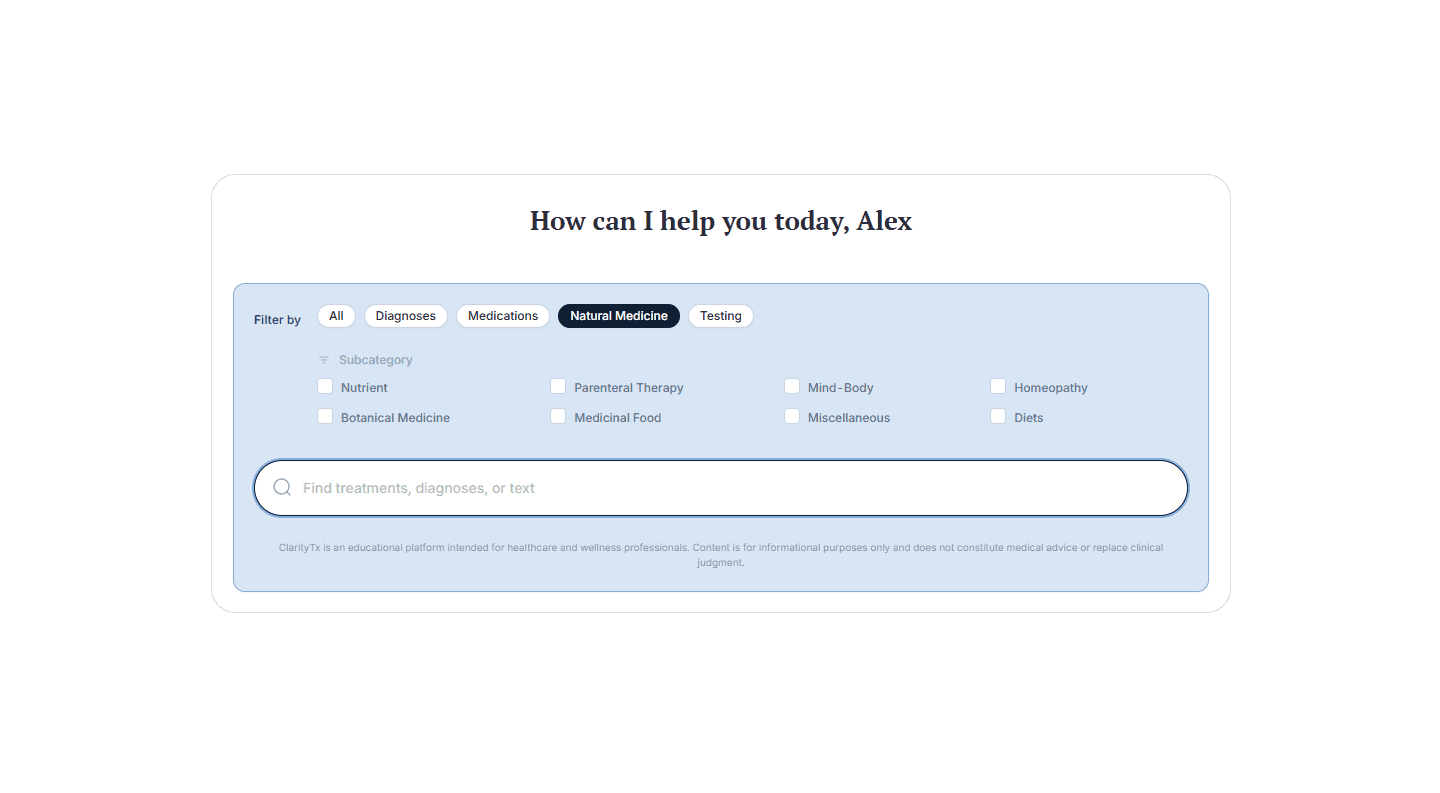
It is not a general-purpose AI tool. ClarityTx is a clinical AI assistant built on a database of over 3,000 clinician-reviewed medical monographs. Clinicians can describe a patient case in plain language -- including symptoms, current medications, and relevant history -- and receive a structured protocol in under eight minutes. The platform automatically flags potential drug-supplement interactions and assigns each recommendation an evidence grade from A to D, with links to the original sources.
The output is designed to be reviewed and edited by the clinician, not used as a finished product. Final clinical judgment stays where it belongs. What changes is the amount of time spent on the research and formatting side, which in complex cases can easily run to an hour or more of after-hours work.
ClarityTx also generates patient-facing versions of the protocol, written in plain language, with clear instructions on what to take, when, and why. For patients who tend to go looking for their own answers online, a clear and well-reasoned plan from their clinician makes a real difference.
For clinicians managing complex cases with multiple systems involved and a patient already taking a self-assembled supplement stack, having a structured, evidence-informed workflow is not just a time-saver. It is part of practicing safely.
The Bottom Line
Supplement safety is not a niche concern in integrative medicine. It is a routine part of patient care that deserves a routine and reliable process. Patients are not going to stop researching their own options or arriving with products already in hand. The question is whether clinicians have a workflow that lets them engage with that reality efficiently and safely.
A structured review process, good interaction checking, and evidence grading are not complicated in concept. The challenge has always been doing them consistently without adding hours to an already full clinical day. That is the problem worth solving.
Put this into practice with ClarityTx
Protocol Copilot synthesizes evidence across 1,500,000+ studies — drug-nutrient interactions, botanical evidence grades, personalized protocols — in under 2 minutes.
Build your first protocol freeElevate Your Practice: Simplify Workflow & Strengthen Patient Care
- Create personalized, evidence-based protocols faster and smarter, freeing you to focus on what matters most: your patients.
- Save hours of research time daily by accessing thousands of research articles and peer-reviewed medical journals in one centralized database.
- Ensure safer, more effective patient outcomes with consistently updated, reliable information at your fingertips.