Not All Clinical AI Is the Same: What Integrative Clinicians Should Look for in AI Tools
General-purpose AI was not designed for integrative medicine. Knowing what to look for -- reviewed sources, interaction checking, evidence grading -- separates tools that help from tools that create new risks.
There is no shortage of AI tools competing for clinicians' attention right now. New platforms get announced regularly, each promising to save time, reduce documentation burden, and improve patient outcomes. For clinicians in integrative and functional medicine, the noise is especially hard to sort through, because most of what is being built was not designed with their workflows in mind.
General-purpose AI tools have real utility for many tasks. But building a supplement protocol, reviewing drug-nutrient interactions, and producing a personalized evidence-informed plan for a patient with multiple overlapping conditions is not a general-purpose task. It requires a specific kind of clinical knowledge base, a specific kind of reasoning, and a tool that was actually built for it.
Knowing what to look for before adopting a new clinical AI tool can save a lot of frustration down the road -- and more importantly, it affects the quality and safety of what ends up in front of patients.
The Gap Between General AI and Clinical AI
Most large language models are trained on broad internet text. They can summarize articles, draft emails, and answer general health questions with reasonable accuracy. What they are not designed to do is apply clinical judgment to a specific patient case, check a supplement stack against a medication list, or grade evidence the way a trained practitioner would.
When a general AI tool is asked a clinical question, it draws on whatever information it was trained on, which may be outdated, unverified, or simply not specific enough to be useful. In a clinical setting, that kind of approximation is not a minor inconvenience. It is a meaningful risk.
Clinical AI built for integrative practice needs to operate from a different foundation: a curated, reviewed knowledge base, structured clinical reasoning, and outputs that a practicing clinician can actually stand behind. The distinction matters, and it is worth asking direct questions about it before committing to any platform.
What a Purpose-Built Clinical AI Tool Actually Does Differently
The differences between a general AI tool and a purpose-built clinical one show up quickly in practice. A few of the most important ones:
- It works from clinician-reviewed source material. General AI pulls from a wide pool of unverified content. A clinical tool worth using is built on monographs and evidence summaries that have been reviewed and maintained by practitioners. That distinction directly affects the reliability of what comes out.
- It checks interactions, not just recommendations. A meaningful clinical AI tool does not just suggest what might help. It also surfaces what might conflict. Drug-nutrient and drug-botanical interaction checking should be built into the workflow, not treated as an afterthought.
- It grades and cites its evidence. Clinicians need to know not just what a tool recommends, but why, and how strong the backing is. An AI that produces recommendations without sourcing them is asking clinicians to take its word for it, which is not a reasonable ask in a clinical context.
- It produces outputs the clinician can edit and own. The clinician's judgment should always be the final layer. A good clinical AI tool generates a starting point that is thorough and evidence-informed, then gets out of the way so the practitioner can review, adjust, and personalize before anything reaches the patient.
Questions Worth Asking Before Adopting Any Clinical AI Tool
Integrative clinicians are often early adopters of new technology, which is a strength. But it also means being on the receiving end of a lot of tools that are not quite ready for clinical use, or that were built for a different kind of practice entirely. A short list of practical questions can filter out a lot of the noise.
- Where does the knowledge base come from, and who reviewed it? If the answer is vague, that is worth paying attention to.
- Does the tool check for drug-nutrient and drug-botanical interactions automatically, or does that require a separate step?
- Are recommendations graded by evidence level, and are sources linked or cited directly?
- Can the output be edited before it reaches the patient, and does the platform make clear that clinician review is part of the process?
- Was it actually built for integrative or functional medicine workflows, or is it a general clinical tool being positioned for that market?
The Workflow Problem AI Should Actually Solve
For most integrative clinicians, the real bottleneck is not access to information. It is time. Reviewing the literature, checking interactions, building a personalized protocol, and then translating all of that into something a patient can actually follow adds up fast. In complex cases, it can easily become an hour or more of work that happens after the appointment is over.
A clinical AI tool that is doing its job well compresses that timeline significantly without cutting corners on the clinical rigor. It handles the research and formatting side of protocol building so the clinician can focus on interpretation, conversation, and follow-up.
That is a meaningful shift. It is not about replacing clinical judgment. It is about removing the parts of the workflow that do not require it, so the parts that do get the attention they deserve.
How ClarityTx Was Built to Meet This Standard
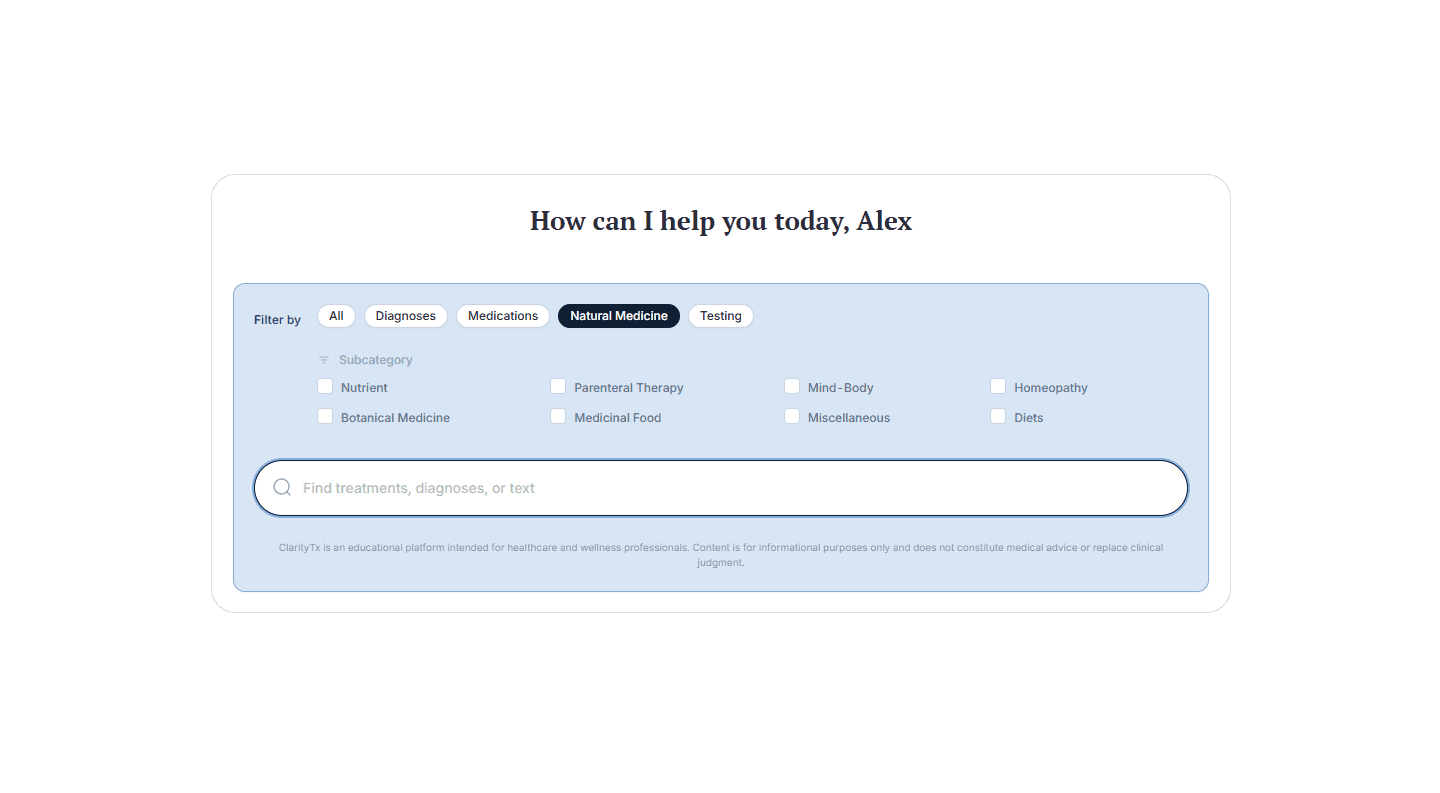
ClarityTx was designed by clinicians who were working inside these workflow problems firsthand. It is not a repurposed general AI tool with a clinical layer added on top. It is built on a database of over 3,000 clinician-reviewed medical monographs, with structured reasoning designed specifically for integrative and functional medicine practice.
Clinicians describe a patient case in plain language and receive a structured protocol in under eight minutes. The platform runs automatic drug-supplement interaction checks and assigns each recommendation an evidence grade from A to D, with direct links to the original sources. Nothing is presented without a rationale the clinician can follow and verify.
The output is a starting point, not a finished product. Clinicians review, edit, and personalize the protocol before anything goes to the patient. ClarityTx also generates a plain-language patient-facing version of the plan, with clear instructions on dosing, timing, and reasoning, so patients leave the appointment with something they can actually use.
For clinicians who have tried general AI tools and found them falling short in clinical contexts, the difference becomes clear quickly. The knowledge base, the interaction checking, the evidence grading, and the workflow design all reflect what integrative practice actually requires.
The Bottom Line
AI is going to play a larger role in clinical practice. That is not really in question. What is worth being deliberate about is which tools get adopted and why. A tool that was not designed for integrative medicine workflows is not a neutral choice. It shapes what clinicians can do efficiently, what gets checked, and ultimately what reaches patients.
The bar for clinical AI in this space should be high: reviewed sources, built-in safety checks, graded evidence, and a workflow that respects the clinician's role as the final decision-maker. Tools that meet that bar exist. It is worth taking the time to find them.
Put this into practice with ClarityTx
Protocol Copilot synthesizes evidence across 1,500,000+ studies — drug-nutrient interactions, botanical evidence grades, personalized protocols — in under 2 minutes.
Build your first protocol freeElevate Your Practice: Simplify Workflow & Strengthen Patient Care
- Create personalized, evidence-based protocols faster and smarter, freeing you to focus on what matters most: your patients.
- Save hours of research time daily by accessing thousands of research articles and peer-reviewed medical journals in one centralized database.
- Ensure safer, more effective patient outcomes with consistently updated, reliable information at your fingertips.